Westward Expansion: From the Mississippi to the Pacific
In 1800 the United States was a narrow strip of states along the Atlantic coast. By 1900 it stretched from ocean to ocean, the third-largest country on earth. The story of how that happened — purchases, treaties, wars, wagon trains, and railroads — is one of the great adventures of American history. It is also a story of loss: for the Native peoples who already lived on that land, westward expansion meant dispossession, war, and removal.
In short
The Louisiana Purchase of 1803 bought about 828,000 square miles from France for $15 million, roughly doubling the size of the United States. Lewis and Clark explored the new territory in 1804–06. Texas was annexed in 1845, the Mexican-American War (1846–48) added the Southwest, and the first transcontinental railroad was completed at Promontory Summit, Utah, on 10 May 1869. The expansion was paid for, above all, by Native peoples, who lost their land through treaties, war, and forced removal.
The Louisiana Purchase and Lewis and Clark
In 1803 President Thomas Jefferson bought the Louisiana Territory from France for $15 million — about 828,000 square miles between the Mississippi River and the Rocky Mountains, for roughly four cents an acre. The price was $11.25 million for the land itself, plus the United States' agreement to take on about $3.75 million of French debts to American citizens. The purchase nearly doubled the country overnight, but it raised a question nobody could answer: what exactly had the United States just bought? France's claim overlapped the homelands of dozens of Native nations, who had not been consulted.
Jefferson sent Meriwether Lewis and William Clark to find out. Their Corps of Discovery left St. Louis in May 1804, traveled up the Missouri River, crossed the Rocky Mountains with the help of the Shoshone woman Sacagawea, and reached the Pacific in November 1805. They returned in 1806 with maps, descriptions of plants and animals new to science, and reports of the peoples they had met. Their journals remain one of the great documents of American exploration.
Trails, gold, and war with Mexico
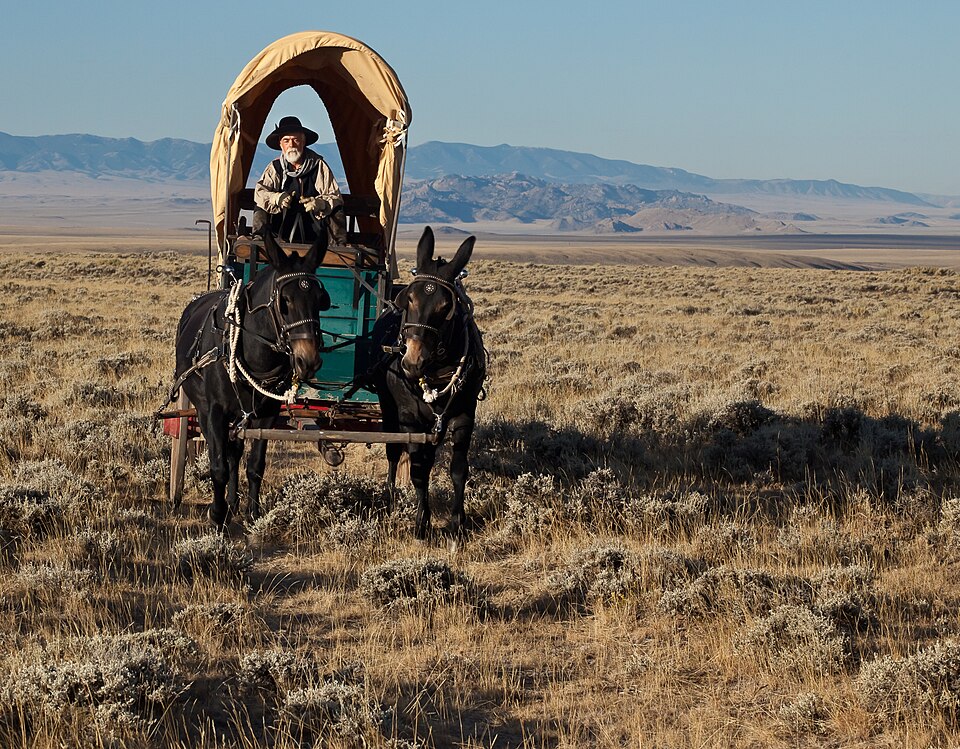
In the 1840s the trickle of settlers heading west became a flood. The Oregon Trail, some 2,000 miles from Missouri to the Pacific Northwest, carried tens of thousands of families in covered wagons — a journey of four to six months. The first wagon party reached Oregon in 1841, and the "Great Migration" of 1843 brought about a thousand people in a single year. In 1845 the United States annexed Texas, which had won independence from Mexico in 1836. A border dispute led to war with Mexico in 1846, and the Treaty of Guadalupe Hidalgo of 1848 gave the United States California and the Southwest — about 525,000 square miles — for $15 million.
The timing was extraordinary: gold had been discovered at Sutter's Mill in California in January 1848, nine days before the treaty was signed. The Gold Rush of 1849 brought some 300,000 people to California in a few years, from every part of the world. San Francisco grew from a village of a few hundred people into a city of tens of thousands almost overnight. California became a state in 1850, and the dream of a continent-spanning nation was suddenly real.
The railroad — and the cost
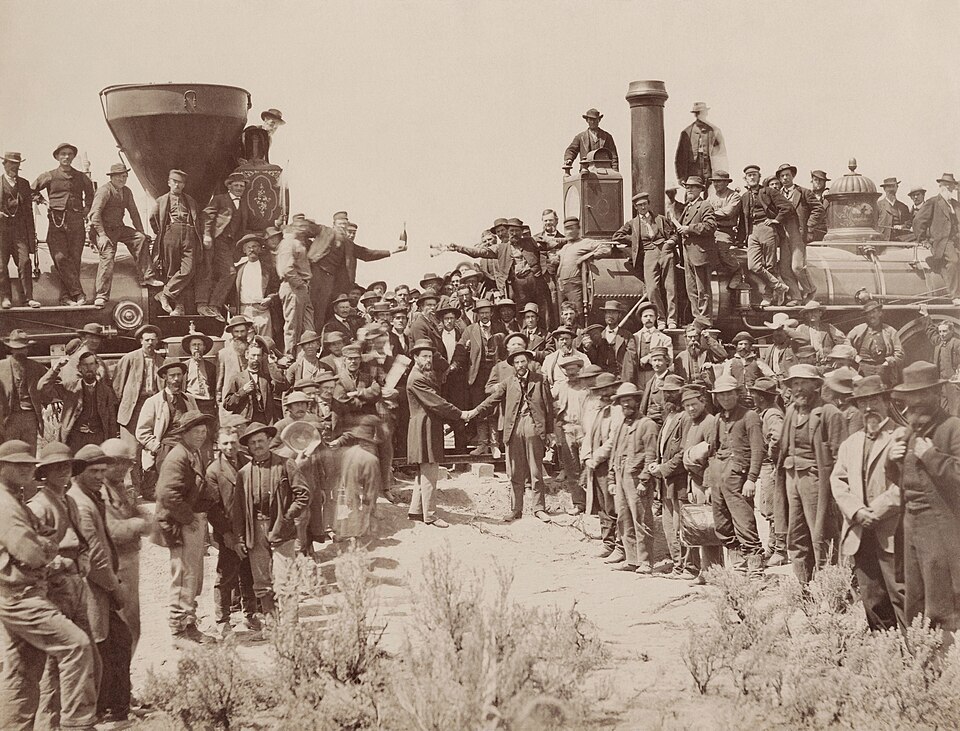
The final link was iron. Two companies raced to build the first transcontinental railroad: the Union Pacific building west from Omaha, Nebraska, and the Central Pacific building east from Sacramento, California, through the Sierra Nevada — its hardest work done by about 10,000 Chinese laborers, with Irish workers building the Union Pacific line. On 10 May 1869 the two lines met at Promontory Summit, Utah, where a golden spike was driven to mark the completion. The journey from New York to San Francisco, which had taken months by wagon, now took about a week.
For Native peoples, the railroad and the settlement it brought were a disaster. The Homestead Act of 1862 offered 160 acres of public land to any settler who would farm it for five years, and millions of acres were given away — land taken from Native nations by treaty, purchase, or force. The bison, on which the Plains peoples depended, were hunted nearly to extinction. Wars with the Sioux, Cheyenne, Apache, and others ran through the 1860s, 1870s, and 1880s, ending with the massacre at Wounded Knee in December 1890. In the same year, the Census Bureau declared that there was no longer a continuous frontier line — the frontier, in the Census's words, was closed. The United States was now a continental nation, and the continent's first peoples had lost almost everything.
| Milestone | Date | What happened |
|---|---|---|
| Louisiana Purchase | 30 Apr 1803 | $15 million buys about 828,000 square miles from France |
| Lewis and Clark set out | May 1804 | Corps of Discovery leaves St. Louis for the Pacific |
| Texas annexed | 1845 | Texas joins the United States; war with Mexico follows |
| Treaty of Guadalupe Hidalgo | 1848 | US gains California and the Southwest for $15 million |
| California Gold Rush | 1849 | About 300,000 people rush to California |
| Homestead Act | 1862 | 160 acres offered to settlers who farm for five years |
| Transcontinental railroad | 10 May 1869 | Lines meet at Promontory Summit, Utah |
Sources: National Park Service; Library of Congress; Encyclopaedia Britannica; Oregon Trail history (oregontrail.ws); US Department of the Interior, Louisiana Purchase history. Checked 28 November 2026.