The Space Race: From Sputnik to the Moon
The Space Race was a contest between the United States and the Soviet Union to reach space first — and it produced one of the greatest achievements in human history. It began with a Soviet satellite the size of a beach ball, and it ended with two Americans walking on the Moon while some 600 million people watched on television. In between, the two superpowers raced through first after first, and the United States bet its pride, and billions of dollars, on a promise made by a young president.
In short
The Soviet Union launched Sputnik 1, the first artificial satellite, on 4 October 1957. The United States answered with its first satellite, Explorer 1, on 31 January 1958, and created NASA later that year. On 25 May 1961 President John F. Kennedy promised to land a man on the Moon before the decade was out. Apollo 11 kept that promise on 20 July 1969, when Neil Armstrong and Buzz Aldrin landed in the Sea of Tranquility while Michael Collins waited in orbit. Twelve astronauts walked on the Moon in all, between 1969 and 1972.
Sputnik shocks America
On 4 October 1957 the Soviet Union launched Sputnik 1, a polished metal sphere weighing about 184 pounds, which beeped a radio signal as it circled the Earth every 96 minutes. Americans could hear it on their radios and see it in the night sky. The shock was enormous: the Soviets, whom many Americans had dismissed as backward, were ahead in the technology that mattered most — rockets that could also carry nuclear weapons across continents. Within weeks the United States rushed its own satellite, Vanguard, which exploded on the launch pad on live television. The humiliation was complete.
The response was swift. The United States launched Explorer 1 on 31 January 1958, and in July 1958 Congress created the National Aeronautics and Space Administration — NASA — to run the civilian space program. Schools poured money into science and mathematics. But the Soviets kept winning firsts: the first animal in orbit (the dog Laika, November 1957), the first probe to reach the Moon (Luna 2, 1959), and the first human in space — Yuri Gagarin, who orbited the Earth on 12 April 1961. Three weeks later, on 5 May 1961, Alan Shepard became the first American in space, on a 15-minute flight that did not orbit the Earth.
Kennedy's promise
On 25 May 1961, President John F. Kennedy went before Congress and set a goal that sounded impossible: "I believe that this nation should commit itself to achieving the goal, before this decade is out, of landing a man on the Moon and returning him safely to the Earth." At the time, the United States had a total of 15 minutes of human spaceflight experience. The Apollo program that followed became the largest peacetime engineering effort in history, employing some 400,000 people and costing about $25 billion — roughly $180 billion in today's money.
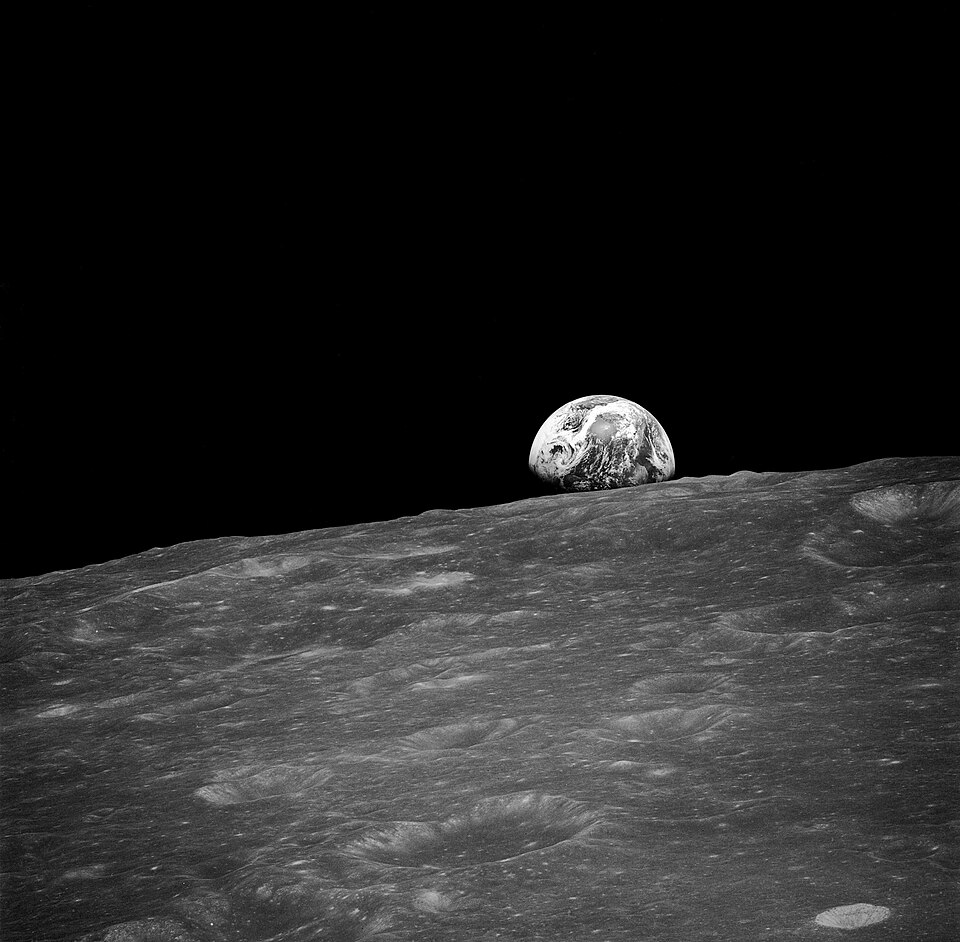
The program advanced step by step: John Glenn orbited the Earth in February 1962; the Gemini missions of 1965–66 learned to rendezvous and dock in space and to walk outside the spacecraft; and Apollo 8, in December 1968, became the first crewed spacecraft to orbit the Moon — its crew reading from the Book of Genesis on Christmas Eve to a worldwide television audience. There were tragedies, too: in January 1967 three astronauts — Gus Grissom, Ed White, and Roger Chaffee — died in a fire aboard Apollo 1 during a ground test, a disaster that forced NASA to redesign the spacecraft.
One small step
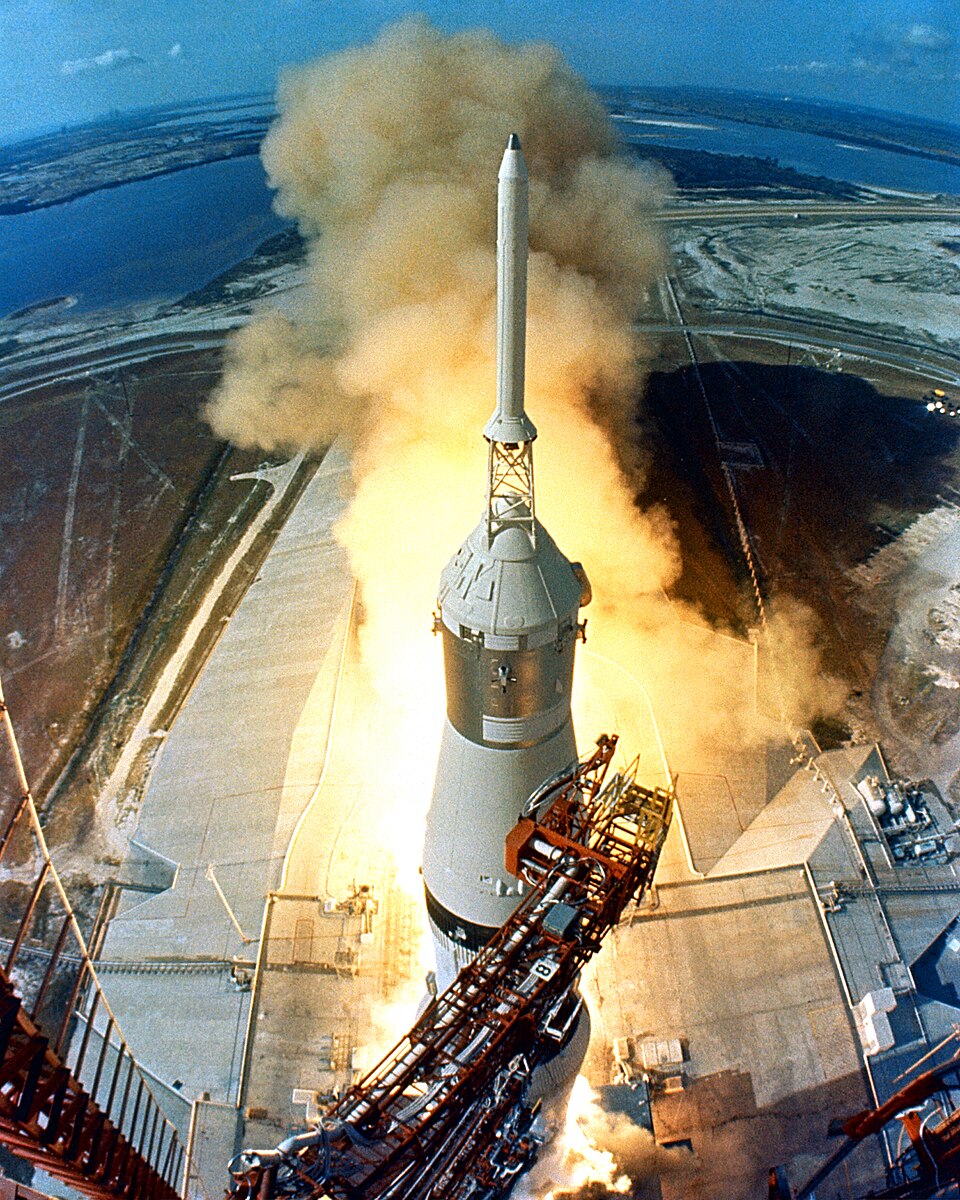
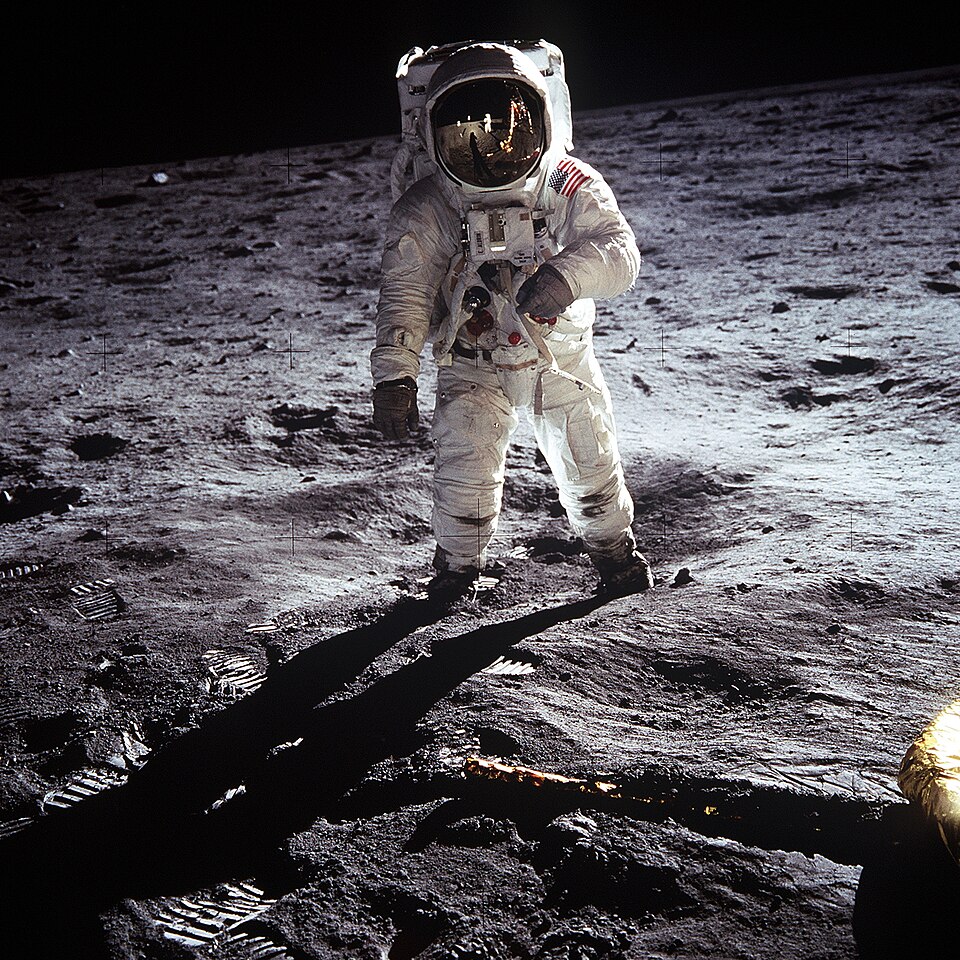
Apollo 11 launched from Cape Canaveral, Florida, on 16 July 1969, carrying Neil Armstrong, Michael Collins, and Edwin "Buzz" Aldrin. After a three-day journey, Armstrong and Aldrin descended to the lunar surface in the lander Eagle, touching down in the Sea of Tranquility on 20 July at 20:17 UTC. About six hours later Armstrong climbed down the ladder and became the first human to walk on the Moon, saying: "That's one small step for [a] man, one giant leap for mankind." Aldrin joined him 19 minutes later. They spent about two and a half hours on the surface, then returned to Collins in orbit and splashed down in the Pacific on 24 July. An estimated 600 million people — about a fifth of humanity — watched the landing on television.
Five more Apollo missions landed on the Moon, the last in December 1972, and 12 astronauts walked on the lunar surface in all. The Space Race was over: the Soviet Union never sent a person to the Moon. But spaceflight did not end. The space shuttle flew from 1981 to 2011, the International Space Station — built with Russia and other partners — has been continuously occupied since 2000, and in the 2020s NASA's Artemis program aims to return astronauts to the Moon. The Space Race began as a Cold War contest; its legacy is the knowledge that human beings can leave their planet — and the ambition, still alive today, to go back.
| Milestone | Date | What happened |
|---|---|---|
| Sputnik 1 launched | 4 Oct 1957 | First artificial satellite; the Space Race begins |
| Explorer 1 launched | 31 Jan 1958 | First American satellite reaches orbit |
| NASA created | Jul 1958 | National Aeronautics and Space Administration founded |
| Gagarin orbits Earth | 12 Apr 1961 | First human in space |
| Kennedy's Moon pledge | 25 May 1961 | Land a man on the Moon before the decade is out |
| Apollo 8 orbits the Moon | Dec 1968 | First crewed flight around the Moon |
| Apollo 11 lands | 20 Jul 1969 | First humans walk on the Moon |
| Last Moon landing | Dec 1972 | Apollo 17; 12 astronauts walked on the Moon in all |
Sources: NASA; Encyclopaedia Britannica, "Space Race" and "Apollo 11"; EBSCO, "Apollo 11"; US Senate, National Aeronautics and Space Act of 1958; Bill of Rights Institute. Checked 28 November 2026.